What is Chan Buddhism?
Chan (禪) is a Chinese Mahāyāna Buddhist school that emerged between the sixth and ninth centuries CE. Its name is the Chinese pronunciation of Sanskrit dhyāna, meaning meditation. The school took shape as Indian Buddhist meditative practice met the Taoist sensibility of Lao Tzu and Zhuangzi: a shared emphasis on naturalness and on a recognition that could not be fully captured in words. Chan became the parent tradition of Japanese Zen, Korean Sŏn, and Vietnamese Thiền. Its central claim was that awakening could be transmitted directly from teacher to student, mind to mind, without depending on texts or doctrinal systems.
Chan, Zen, and adjacent traditions
Chan is often used interchangeably with Zen, but Zen is the Japanese branch of Chan, not the same school. Zen's Sōtō/Rinzai polarity is a Japanese refinement of distinctions the Chinese houses drew differently. Korean Sŏn and Vietnamese Thiền are the other major exports of the same Chinese parent. Chan is also not anti-intellectual, despite how some Western writing has framed it. The motto a special transmission outside the scriptures, not founded on words and letters is a polemical compression, not an institutional policy. Chan monasteries trained monks in the Diamond Sūtra, the Lankāvatāra, the Vimalakīrti, and the Platform Sūtra, and produced some of the largest commentary literature in the Chinese Buddhist canon. The same houses that assembled the kōan collections also produced sustained treatments of Madhyamaka emptiness and Yogācāra consciousness analysis. The phrase not founded on words and letters names the goal the practice points at, not a rejection of the transmission medium through which the school passed its knowledge.
The Chinese reception
Mahāyāna Buddhist texts and teachers began reaching China along the Silk Road in the first centuries CE. They arrived in a culture that already had its own contemplative tradition: the Taoist writings of Lao Tzu and Zhuangzi, with their sense of the Tao as an unnameable ground and *wu wei* as the natural mode of moving within it. The first translators worked with Taoist vocabulary already in hand. Sanskrit dharma was sometimes rendered as Tao; nirvāṇa was approached through Taoist words for nothingness and non-action. Over the fifth and sixth centuries, something emerged that was no longer recognisably Indian Mahāyāna and not quite Chinese Taoism. The Chinese began calling it Chán, after the meditation (dhyāna) the school foregrounded. The motto attributed to Bodhidharma, almost certainly composed in the eighth or ninth century rather than the sixth, captured the school's self-description: a recognition transmitted mind to mind, not dependent on the textual apparatus the older Buddhist schools had built.
Patriarchs and the Southern turn
The lineage Chan settled on by the late Tang runs from Bodhidharma, the semi-legendary Indian figure said to have arrived in China in the early sixth century, through five Chinese successors down to Huineng (638–713), the sixth and last patriarch of the unified line. After Huineng the lineage split into what the tradition calls the five houses. The most consequential moment in Chan's self-formation was the promotion of Huineng's sudden awakening over the rival Northern school of Shenxiu. The Platform Sūtra records the verse contest in which Huineng's poem surpassed the head monk's. From the Southern lineage came the five houses — Linji, Caodong, Yunmen, Fayan, and Guiyang — whose writings became the school's classical literature: the gōng'àn (*kōan*) collections of the Blue Cliff Record and the Gateless Gate, the dialogue records of masters like Linji Yixuan and Zhaozhou Congshen, and the Caodong house's just sitting (zhǐguǎn dǎzuò, later Japanese *shikantaza*) developed by Dongshan Liangjie and Hongzhi Zhengjue. In the twelfth and thirteenth centuries, Eisai carried the Linji line to Japan as Rinzai and Dōgen carried the Caodong line as Sōtō. This is the route by which what English readers encounter as Zen reached the West.
In the index
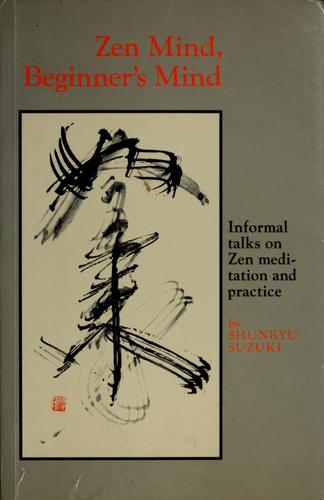
Alan Watts's *The Way of Zen* gives the most extensive single account of the Chinese half of the Chan lineage in the index. Its first half covers the Chinese background: Taoism, the early translators, the patriarchal lineage, and the Southern–Northern split. D. T. Suzuki is the other major twentieth-century English voice for this material. His essays draw on the Tang patriarchal records and the Song kōan collections. Shunryu Suzuki's *Zen Mind, Beginner's Mind* is rooted in the Caodong/Sōtō line of Dōgen and brings the just sitting instruction of the Caodong house into English. Adyashanti's *Do Nothing* is the index's clearest contemporary expression of the no-effort attention that house cultivated. Adyashanti trained in the Sōtō Zen lineage of Maezumi Roshi, two transmissions from the Caodong source. The Plum Village and Thich Nhat Hanh on emptiness material carries the Vietnamese Thiền inheritance, blending Linji kōan practice with engaged-Buddhist social commitment. The Zen entry maps the Japanese descent in more detail.