What is Huineng?
Huineng (惠能, 638–713) was the Sixth Patriarch of Chan Buddhism. He is traditionally depicted as an illiterate woodcutter from southern China who was awakened by a single line of the Diamond Sūtra. His attributed text, the Platform Sūtra of the Sixth Patriarch, is the only Chan text granted the rank of sūtra in the Chinese Buddhist canon. Every surviving school of Chan and Japanese Zen traces its lineage through him.
The marketplace and the Fifth Patriarch's robe
The Platform Sūtra (Tánjīng) is the text through which the tradition remembers Huineng. It opens with him as a young illiterate firewood-seller in Lingnan, at the southern edge of Tang-dynasty China. He hears a customer recite a single line of the Diamond Sūtra: produce a mind that does not abide anywhere. The recitation awakens him. He travels north to the monastery of the Fifth Patriarch Hongren (601–674) on Mount Huangmei. There the text records a poetry contest. The head monk Shenxiu compares the mind to a polished mirror that must be wiped clean of dust. Huineng's reply: originally there is not a single thing, where could dust alight. Hongren secretly transmits the robe and bowl to Huineng at midnight and tells him to flee south. The teaching line passes to an illiterate Cantonese layman over the heads of the institutional cadre.
Historians dispute the reliability of every episode in the Tánjīng. Modern Sinology, from Hu Shih and Yanagida Seizan in the mid-twentieth century onward, places the text in its present form in the late ninth century. It was composed by Huineng's lineage, not by Huineng himself. The famous poetry contest is now read as a literary device of the Heze school, used to claim succession to Hongren over the Northern school of Shenxiu. What is not contested: by the early ninth century the only surviving Chan was the Southern Chan that traced itself to Huineng. Whatever the historical Huineng said or did, the Platform Sūtra became the doctrinal foundation from which all later Chan and Japanese Zen would work.
Sudden awakening and the Southern school
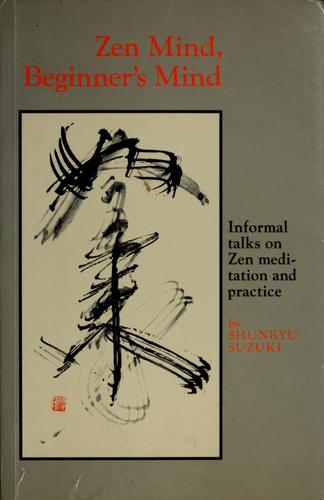
The central doctrine of the Platform Sūtra is dùnwù, sudden awakening, set against the gradual cultivation (jiànwù) the text projects onto the Northern school. The contrast is polemical. Shenxiu's actual teaching was not as gradualist as the text depicts. But the Southern Chan move is real. Its claim is that buddha-nature is not something to be built up through practice but is already the ground of every mind. Cultivation removes the obscuration; it does not construct something new. A single recognition can complete the entire Path. The marketplace woodcutter who has done no formal practice can in principle surpass the senior monk who has done forty years of it. The kōan curriculum of the Linji line and the shikantaza of the Caodong line are both methods pointing to this same recognition. The Way of Zen traces the lineage from Huineng forward in Alan Watts's idiom. Zen Mind, Beginner's Mind presents Shunryu Suzuki's Sōtō rendering of the originally not a single thing posture as everyday practice.
Where the lineage surfaces in the index
Every surviving school of Chan and Japanese Zen descends from Huineng through one of his five named heirs: Nanyue Huairang, Qingyuan Xingsi, Heze Shenhui, Yongjia Xuanjue, and Nanyang Huizhong. These heirs produced the Five Houses (wǔ jiā) of the late Tang. Two of those houses survive today. The Línjì line (Japanese: Rinzai) runs through Mazu → Linji → Yangqi → … → Hakuin → modern Rinzai. The Cáodòng line (Japanese: Sōtō) runs through Dongshan → Caoshan → … → Tiantong Rujing → Eihei Dōgen → modern Sōtō. All the English-language Zen material in this index is the late inheritance of those two lines. D. T. Suzuki was the figure through whom Linji-line Chan reached the twentieth-century West, and through whom the Platform Sūtra was first read by an English audience as a primary text. Adyashanti's *Do Nothing* represents a contemporary non-monastic Zen-derived register in which the not abiding anywhere of the Diamond Sūtra line keeps returning. From the Mahāyāna side, Thich Nhat Hanh's emptiness teaching and the Plum Village reflection work the same prajñāpāramitā substrate that the Platform Sūtra is a Chan adaptation of.
What he isn't
Huineng is not the founder of Chan. The tradition he received was a century older, traced to Bodhidharma and through him to the Indian dhyāna tradition. He is also not the historical author of the Platform Sūtra. The text in its present form is a late-Tang composition by his lineage. What the tradition does make him is the figure on whom Chan staked its central claim: that recognition does not require institutional credentials. An illiterate Cantonese woodcutter could carry the transmission over the head of a senior monk. Awakening, as the sūtra literature describes it, is in principle accessible to any mind, regardless of training, language, or class. Whether or not the historical Huineng said any of the words the Tánjīng puts in his mouth, this claim has been the structural commitment of every Chan and Zen lineage since.