SMSpirituality Media
An index of inner knowledge
items · voices · topicsEdited by one editor Waxing crescent
Wednesday, 20 May 2026
INDEX/Lexicon/Text/The Way of Zen
/lexicon/the-way-of-zen

The Way of Zen

Text
Definition

Alan Watts's 1957 popularising synthesis of Zen Buddhist history, doctrine and practice — the book most responsible for placing the technical vocabulary of the Japanese tradition into mid-twentieth-century Anglophone circulation. Watts wrote The Way of Zen explicitly on the platform D. T. Suzuki had laid in the preceding three decades, and the preface is candid about the debt. The book is read today as a starting-point rather than a finished doctrine: accurate on the trajectory from Chinese Chán into Japanese Zen, loose on the points of practice the form depends on for its working.

written by editorial · revised continuously

What the book is

The Way of Zen was published by Pantheon in 1957, the same year Alan Watts left the Episcopal priesthood and the year before he relocated permanently from New York to California. The book has two halves. The first traces the Chinese background — Taoism and the *wu wei* inheritance, the early translators who brought the Prajñāpāramitā literature into Chinese, the patriarchal lineage of Bodhidharma through Huineng, the southern–northern split, the Platform Sūtra — before turning to the Japanese reception in the second half, with chapters on zazen, the kōan curriculum, and the cultural pervasion of the form through tea ceremony, painting, swordsmanship and haiku. The register is the popular-philosophical one Watts had been refining since The Spirit of Zen (1936): discursive prose, generous quotation of primary sources in the existing English translations, and a deliberate avoidance of the academic apparatus. The book runs to roughly 240 pages in the standard Pantheon edition and has remained continuously in print since publication.

The Suzuki platform

Watts is explicit in the preface that the book would not have been possible without the two preceding decades of work by D. T. Suzuki. The Essays in Zen Buddhism — three volumes published between 1927 and 1934 — and Suzuki's later Manual of Zen Buddhism and Zen Doctrine of No-Mind were the platform on which a popular English-language synthesis became possible at all; before them, the Anglophone reading public had no working categories for satori, kenshō, zazen or kōan distinct from the broader Christian-mystical vocabulary the late nineteenth century had reached for. Suzuki's *Introduction to Zen Buddhism* is the volume that did the most institutional work, and his *Manual of Zen Buddhism* is the working compendium Watts cites repeatedly. Watts's own contribution was the popularisation: organising the material into a narrative arc a non-specialist reader could follow, and dropping the apparatus that had kept the earlier scholarship in academic circulation. The two voices are complementary on the corpus's own self-understanding — Suzuki provides the documentary record, Watts the readable synthesis — and the index treats them as a single complementary entry-point into the Zen tradition in English.

Where the book sits in the index

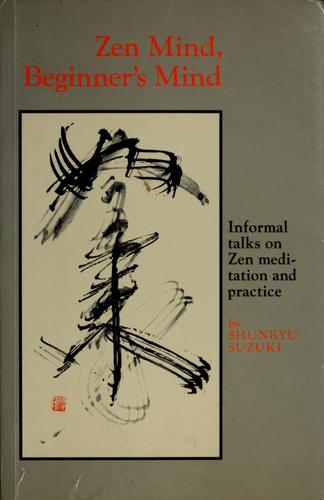
Alan Watts's *The Way of Zen* is the index's most extensive single account of the Chinese half of the Chan-and-Zen lineage and is the closest thing to a working historical introduction in English an interested reader is likely to need. D. T. Suzuki's *An Introduction to Zen Buddhism* is the earlier scholarly companion, and his *Manual of Zen Buddhism* the working compendium Watts drew on. Shunryū Suzuki's *Zen Mind, Beginner's Mind* — no relation, and composed in California a decade later — is the practice-side counterpart Watts's text did not provide: where The Way of Zen maps the form from outside, Zen Mind sits inside it and reports from the cushion. Watts's earlier *The Wisdom of Insecurity* is the popular-philosophy precursor whose anxious-modern register The Way of Zen eventually domesticates inside the Buddhist material the later book takes as its subject. Adyashanti's *Do Nothing* is the contemporary American descendant of the Sōtō Zen lineage of Maezumi Rōshi whose institutional emergence in California in the 1960s and 1970s was made possible, in part, by the audience Watts's books had prepared. The Vietnamese Thiền inheritance the Chán root also produced reaches the index through Thich Nhat Hanh on emptiness, signlessness and aimlessness and the Plum Village teaching from Br. Troi Duc Niem, both of which carry the same Chinese ancestry Watts's first half traces.

What it isn't

The Way of Zen is not a manual of practice. Watts had not himself completed a full sesshin, did not train in a sustained lineage, and is candid in his autobiographical writing about the gap between the form he describes and the form he had personally sat inside. Readers who treat the book as a substitute for sitting practice will not find what its later popularity sometimes seemed to promise; readers who treat it as the historical and conceptual orientation for a practice taken up elsewhere will find it does that work well. The book is also not a doctrinally precise treatment of the points of kōan introspection, the shikantaza instruction the Sōtō line carries, or the dokusan check-valve through which a working transmission passes. For those, the practitioner-voices in the index — Shunryū Suzuki, Adyashanti, Thich Nhat Hanh, the Plum Village material — carry the report from inside the form. Watts carries the report from outside it, accurately as far as that goes, and not further.

— end of entry —

SM
Spirituality MediaAn index of inner knowledge

Essays, lectures, a lexicon, and a hand-curated reading list — read, cleaned, and cross-linked.

Est. 2024·Independent
Newsletter

One letter, every Sunday morning.

A note from the editors with what we read this week and one short recommendation. No tracking; one click to unsubscribe.

Est. 2024
© 2024–2026 Spirituality Media Ltd