What is the Tibetan Book of the Dead?
The Tibetan Book of the Dead is the English name for the Bar do thos grol chen mo, a Vajrayāna scripture from fourteenth-century Tibet. The text was attributed to the eighth-century master Padmasambhava and uncovered by the tertön Karma Lingpa. It is an oral-recitation guide: a lama reads it aloud to a dying person at the moment of death and continues for the following forty-nine days of the post-death bardo cycle. The aim is to help the consciousness recognise the nature of mind and reach liberation.
Tibetan Book of the Dead vs related texts and teachings
The title Tibetan Book of the Dead was invented by Walter Evans-Wentz in 1927, modelled on the Egyptian Book of the Dead. It does not come from the Tibetan; the tradition's own title is the Bar do thos grol. The text is also commonly mistaken for a literal map of what happens after death. In Tibetan terms it is not. The deities and lights are named in the text itself as projections of the practitioner's own mind. The test of the curriculum is whether the dying consciousness can recognise them, not whether they appear in the order described. The text is also not reserved for the deathbed. The Kagyu and Nyingma reading is that the dying bardo is the most extreme case of a recognition that meditation, dream, and ordinary-life bardos are continuously training.
The text and its composition
The Bar do thos grol chen mo means the Great Liberation through Hearing in the Intermediate State. It is not a single text but one cycle within the larger Kar gling zhi khro (Karma Lingpa's Peaceful and Wrathful Deities) corpus. Karma Lingpa, a Vajrayāna tertön, uncovered the cycle in the fourteenth century on the slopes of Mount Gampodar. The transmission lineage traces back to Padmasambhava, who is said to have concealed it for retrieval at the right moment. This is the gter ma genre: texts engineered to re-emerge at the appropriate karmic juncture. The title works at three levels. Literally: liberation through hearing. Operationally: recognition triggered by the auditory recitation at the moment the dying person's ordinary perception has collapsed. Soteriologically: the claim that hearing the pointing-out instruction, under bardo conditions, can itself produce liberation. The text was first transmitted within the Nyingma school and spread from there to the wider Tibetan contemplative curriculum.
The text is an oral-recitation manual, read aloud at the moment of death and through the forty-nine days of the post-death bardo cycle. The logic is that the dying consciousness, even after the ordinary senses have ceased, retains enough auditory awareness for the recitation to function as a pointing-out instruction. The text maps the peaceful and wrathful deities of the dharmatā bardo, one hundred and ten figures in the standard enumeration. Each is named as a projection of the practitioner's own mind; the text urges recognition rather than pursuit or flight. It also maps the six lights of the srid pa bardo as the six karmic destinations of the six realms.
Western reception
Walter Evans-Wentz published the first English translation in 1927. The translation was made in collaboration with the Sikkimese lama Kazi Dawa Samdup, with Evans-Wentz adding a Theosophist framing that the Tibetan tradition does not share. Carl Jung wrote a long psychological introduction for the 1957 second edition, reading the bardo deities as projections of the unconscious. This is broadly compatible with the text's own claim that the deities are projections of the practitioner's mind, though Jung's unconscious and the Tibetan sems are not identical concepts. In 1964 Timothy Leary, Ralph Metzner, and Richard Alpert published The Psychedelic Experience, using the Bar do thos grol as a guide for LSD sessions on the proposition that ego-dissolution in the trip and perceptual collapse in the dying bardo are structurally similar. That proposition was contested at the time and remains so, but the book brought Tibetan death-contemplation into the American counterculture at scale.
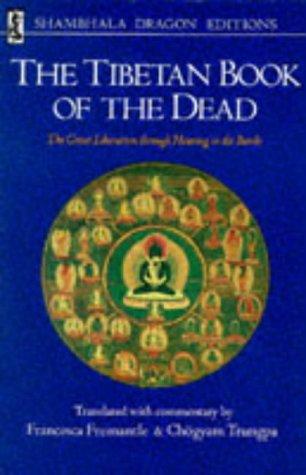
The translation most contemporary practitioners encounter first is the 1975 Chögyam Trungpa–Francesca Fremantle rendering. It was the first made from inside the Karma Kagyu lineage that had transmitted the text for six centuries, with Trungpa's commentary as the framing layer. Robert Thurman's 1994 translation, made within the Geluk curriculum, became the standard academic edition. Sogyal Rinpoche's Tibetan Book of Living and Dying (1992) is the most-read Western companion volume. It is not a translation of the Bar do thos grol itself but a presentation of the bardo curriculum for a general audience.
Where the curriculum lives in the index
Karma Lingpa's *Tibetan Book of the Dead* is in the index in its English translation. Chögyam Trungpa Rinpoche's *Cutting Through Spiritual Materialism* is the canonical English-language Kagyu text and the entry point through which the bardo reading entered modern American practice. Pema Chödrön's *When Things Fall Apart* is the most-read Western application of the Bar do thos grol's core claim: that the dying bardo is structurally identical to ordinary moments of loss or disintegration. Her course on awakening compassion, teaching on uncertainty, and conversation on becoming more alive develop the same curriculum in longer form. Tenzin Palmo's *Cave in the Snow* is the first-person account of twelve years of Drukpa Kagyu solitary retreat, the closest direct illustration of the text's claim that the dying bardo is recognisable to someone who has stabilised recognition in the meditation bardo.